

Asia Pacific Climate & Health Research Alliance
Mission
We are working to combat the health impacts of climate change and pollution by combining rigorous on-the-ground data collection with cutting-edge, field-tested interventions in Eastern Indonesia, one of the world’s most at-risk regions.
About
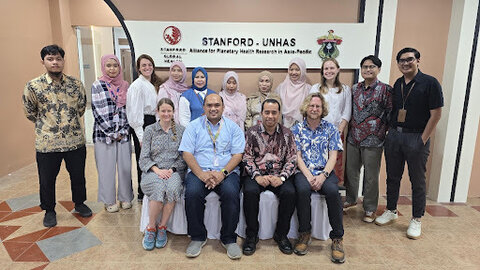
The Stanford University-Hasanuddin University (UNHAS) Alliance for Planetary Health in the Asia Pacific is the result of more than a decade of collaboration between researchers at both institutions. With experienced and dedicated field staff based in Makassar, Indonesia, a coastal city in Eastern Indonesia, the alliance allows for on-the-ground, field-intensive research. Makassar is a rapidly developing and climate sensitive area with a dense urban population.
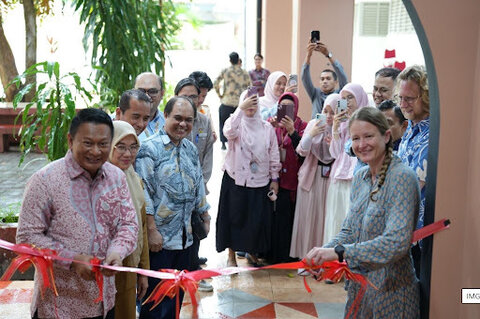
Challenges the community faces — such as more frequent extreme heat exposure, mosquito borne disease, and increasing levels of pollution — mirror those faced across the Asia Pacific region and the world. Our collaboration positions Stanford and UNHAS to address pressing problems in planetary health with potential for wide benefit.
Research Projects
Drones & Dengue
Discarded tires, plastic bottles, and piles of household trash create breeding “hotspots” for mosquitoes seeking shallow water-holding containers to lay their eggs. Aedes aegypti mosquitoes are the primary vectors that transmit dengue, chikungunya, and Zika – three diseases with no specific treatments or widely available vaccines. Watch to learn more about how drones are tracking trash, mosquitoes, and disease:
With global dengue cases affecting millions of people annually – now established in 167 of 188 countries – the best defense is stopping these mosquitoes before they bite. People living in informal settlements have the highest risk of disease burden due to a lack of regular trash collection.
Our research team is conducting a combination of drone, vector, and human subjects field work in informal settlements to better understand local drivers of infectious disease transmission and inform more accurate and efficient vector control efforts.
An ongoing longitudinal mother child cohort study tracks environmentally mediated infectious diseases in young children, such as dengue fever. This human cohort study is combined with an active drone mapping program as well as ground truth vector surveillance and qualitative community studies to evaluate local drivers of disease and design interventions to mitigate impacts on human health.
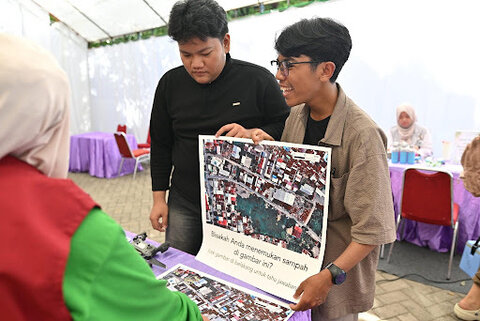
Our Indonesia-based “drones and dengue” research program is collaborating with other programs in Africa and the Americas. This multi-country, interdisciplinary research continues to grow through the joint efforts of multiple labs at Stanford and funding from a Stanford Woods Institute Human and Planetary Health Early Career Award, Stanford Center for Innovation in Global Health Seed Grant, and a Stanford Doerr School of Sustainability Accelerator grant.
Plus, a spotlight on researcher Morgan Tarpenning:
Learn more about HPH's Disease Ecology in a Changing World (DECO) program
Health Effects and Strategies for Adaptation to Extreme Heat
Extreme heat poses an exponentially growing threat to human health, livelihood, and productivity.
Extreme heat exposure increases risk for cardiovascular events, strokes, kidney failure, pregnancy complications, childhood stunting, poor mental health outcomes, and other damaging impacts. The urban poor, who lack the resources to adapt to extreme heat, represent a large and growing group at high risk for mortality and morbidity: 1.1 billion people live in informal settlements and that population is expected to grow by 2 billion over the next 30 years. UN models suggest that the number of urban poor living in extreme heat could rise 700% by 2050.
Heat exposure also has an economic cost: research by the Asian Development Bank suggests that three-fourths of workers in Asia and the Pacific are exposed to excessive heat, and that work output could drop by more than 50% by 2030 for those who labor outside.
Indonesia combines year-round high temperature and humidity levels, dense urban and informal settlement communities, and a large number of industries requiring outdoor labor in extreme heat conditions, making our site in Makassar an ideal place to develop, pilot, and evaluate solutions for heat exposure that can be applied throughout the Asia Pacific region and globally.
Our team is building a field data-collection platform in Makassar, Indonesia to characterize heat exposure, measure the health effects of heat, and better understand options for heat adaptations in formal and informal urban communities and outdoor laborers. We use sensors, surveys, and wearable devices to characterize heat exposure and its effects on human health.
We are testing heat adaptation strategies, including the implementation of reflective “cool” roofs and novel insulative materials to decrease indoor temperatures. We are piloting and evaluating personal cooling innovations to protect laborers. We are building pipelines to model household-level heat exposure on large urban scales, allowing for more accurate quantification of heat-related health burdens, identification of impactful interventions.
Our work on heat adaptation is funded by the Stanford Doerr School of Sustainability Accelerator and has received follow-up funding from Stanford Woods Institute Human and Planetary Health Early Career Award, Stanford Woods Institute Environmental Ventures Projects, and the Stanford King Center on Global Development.
Air Pollution and Pediatric Respiratory Disease
Air pollution, responsible for over 8 million deaths annually, is one of the world's most pressing health crises, disproportionately affecting children with over 700,000 under-5 deaths in 2021. Children are particularly vulnerable to air pollution due to higher outdoor activity levels, greater air intake relative to their body weight, and developing respiratory systems. Our research team is conducting an acute respiratory disease study to examine the relationship between short-term fluctuations in air pollution levels and pediatric respiratory disease rates. This work is funded by a seed grant from the Stanford Center for Innovation in Global Health.
Microplastics and Pediatric Health
There is increasing evidence that microplastic exposure in humans is increasing at an alarming rate, with potential health impacts that are only starting to be recognized. Children are at the highest risk of microplastic exposure and downstream health impacts. Indonesia is the second largest plastic waste producer globally and waste services have not kept pace with rapid urbanization. Mismanaged plastic waste ends up on the land and in the oceans, contaminating local and global marine food supplies. Due to unreliable access to clean water, there is also a heavy reliance on water storage in plastic containers and plastic packaged drinking water, further increasing microplastic exposure in Indonesia. We have launched a study to evaluate microplastic exposure in young children to investigate the magnitude of the problem, potential sources of exposure, and impacts on the gut microbiome. This work is funded by a seed grant from the Stanford King Center on Global Development.
Partners

People
Joelle Rosser, Assistant Professor, Division of Infectious Disease and Geographic Medicine, School of Medicine, Stanford University
John Openshaw, Assistant Professor, Division of Infectious Disease and Geographic Medicine, School of Medicine, Stanford University
Rishee Jain , Associate Professor, Civil and Environmental Engineering, Stanford University
Debbie Senesky, Associate Professor, Aeronautics and Astronautics Department and the Electrical Engineering Department, Stanford University
Michael Snyder, Professor, Genetics, Stanford University
Erin Mordecai, Associate Professor, Biology and Senior Fellow at the Stanford Woods Institute for the Environment
Guilio De Leo, Professor of Oceans, Earth Systems Science and Senior Fellow at the Stanford Woods Institute for the Environment
Desiree LaBeaud, Professor of Pediatrics, Infectious Disease, Stanford University
Ansariadi, Director of Partnerships, Centre for Epidemiology and Population Health Studies, UNHAS
Andang Suryana Soma, Watershed Management and Forestry, Hasanuddin University
Isra Wahid, Mosquito Borne Diseases and Entomology, Hasanuddin University
Allison Henning, Global Health Research Fellow, Stanford University
Kavita Dave Coombe, Lab Manager, Stanford University
Andrew Chamberlain, Research Scientist, Stanford University
Select publications
Enhancing Aedes aegypti breeding site detection: A deep learning approach to tire identification in unmanned aerial vehicle imagery from urban Indonesia
Stanford Author(s): Mohammad Hassan, Andrew Chamberlin, Morgan Tarpenning, Whitney Weber, Kavita Coombe, Giulio De Leo, Joelle Rosser
Focus area(s): Disease ecology in a changing world | Published: April 2026
New frontiers for unmanned aerial vehicles in planetary health research
Stanford Author(s): Morgan Tarpenning, Katherine Woo, Andrew Chamberlin, Kavita Coombe, Joelle Rosser
Focus area(s): Disease ecology in a changing world | Published: March 2026
Comparison of unmanned aerial vehicle imaging to ground truth walkthroughs for identifying and classifying trash sites serving as potential Aedes aegypti breeding grounds
Stanford Author(s): Joelle Rosser, Desiree LaBeaud, Giulio DeLeo
Focus area(s): Disease ecology in a changing world, Pollution and health | Published: March 2025
Seroprevalence, incidence estimates, and environmental risk factors for dengue, chikungunya, and Zika infection amongst children living in informal urban settlements in Indonesia and Fiji
Stanford Author(s): Joelle Rosser, John Openshaw, Esra Buyukcangaz
Focus area(s): Disease ecology in a changing world | Published: January 2025
Development of a trash classification system to map potential Aedes aegypti breeding grounds using unmanned aerial vehicle imaging
Stanford Author(s): Joelle Rosser, Morgan Tarpenning, Andrew Chamberlin, Giulio De Leo, Desiree LaBeaud
Focus area(s): Disease ecology in a changing world, Pollution and health | June 2024
News & Recent Events
Environmental Health Expo Day

Stanford-UNHAS Alliance for Planetary Health Event
Mother’s Day, May 11, 2026, was a day of discussion between our team, local health leaders, and the community about how the environment shapes the health of the next generation.
Drones and AI take flight to combat mosquito-borne disease

Stanford Report
April 7th, 2026