Alice Heiman
Computer Science Undergraduate
Did you know that Brazil is named after a tree?
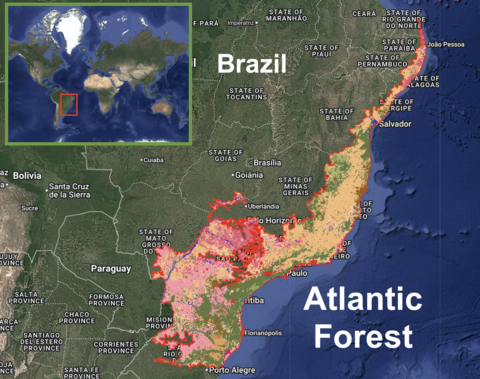
Brazil, short for "Terra do Brasil," means the land of brazilwood. For centuries, exporting its red dye and quality timber made Brazil a coveted monopoly. But today, this endangered tree can only be found in the Atlantic Forest.
Covering the east coast of Brazil, the Atlantic Forest is one of the world's most important hotspots for life with over 20,000 species of plants and 2,000 species of vertebrate animals.
Yet, only 12-15% of the forest remains, causing major local and global disruptions.
For instance, according to the World Health Organization (WHO), over 75% of emerging infectious diseases arise in areas with disrupted ecosystems from deforestation or land-use change. Biodiversity is also essential for food supply and forest health. 70-90% of tropical forests depend on animals to disperse their seeds, and more than 75% of global food crops rely on pollinators. Moreover, the Atlantic Forest provides services such as clean water and air to about 150 million Brazilians.
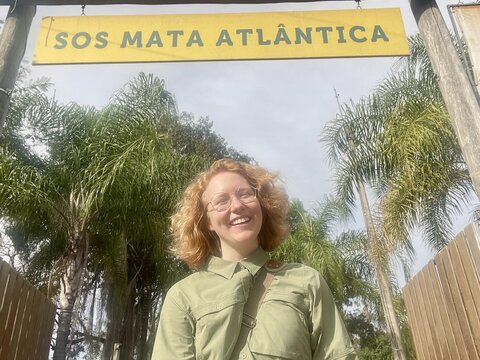
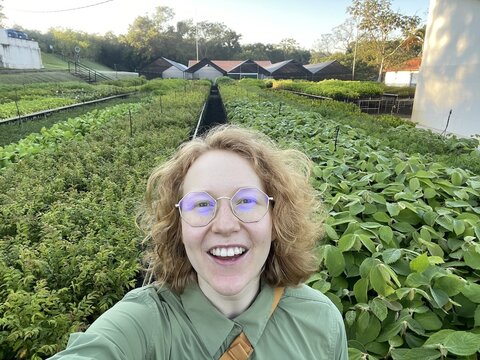
In summer 2025, I worked with the Stanford Natural Capital Project to help SOS Mata Atlãntica, one of the largest restoration organizations in Brazil, address its challenges. We studied how the water quality could be improved through restoration efforts.
The Water-Forest Link
The Tiête water basin, a giant funnel collecting rainfall and runoff west of São Paul, provides water for 18 million Brazilians. But it's severely polluted, and demand now outstrips supply.
Water pollution is partly due to tree clearing. Forest canopies and leaf litter slow runoff and erosion, keeping sediment out of streams. Tree roots host bacteria that break down harmful chemicals, and forests buffer the spread of excess compounds. Therefore, forests are critical to the water supply and quality, directly impacting human health.
Trees along riverbanks (so-called riparian buffers) matter significantly. They stabilize banks, form a last line of defense against runoff and fertilizers, and create wildlife corridors.
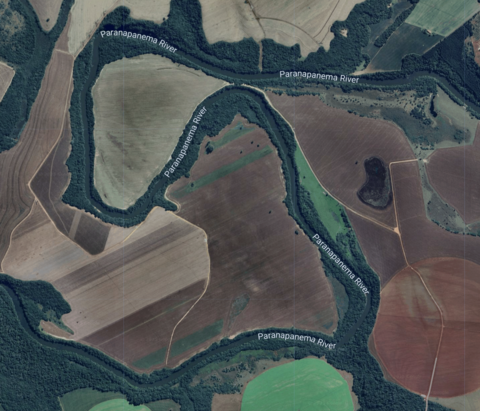
Brazilian law formally protects this riverside land. But restoring every buffer is impossible: resources are limited, much land is private, and enforcement across large areas is hard. So we must be strategic about where to plant.
Quantifying Nature's Benefits
Nature’s benefits to people (such as clean water, shelter, spaces for reflection and connection) are called ecosystem services.
Just as we value human and physical capital, we can value natural capital. These ideas, spearheaded by Professor Gretchen Daily and the Natural Capital Project (NatCap), give decision-makers tools to evaluate natural solutions against alternatives.
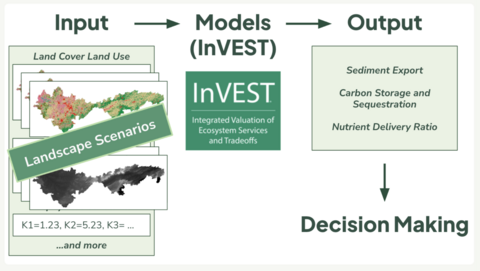
NatCap's InVEST models can simulate the flow of water, nutrients, and sediment through the landscape. By running them on the current landscape (baseline) and a hypothetical restored one, we can compare scenarios and find where restoration helps most. We ran the carbon, nutrient delivery, and sediment delivery models on data from the priority area to compare restoration scenarios.
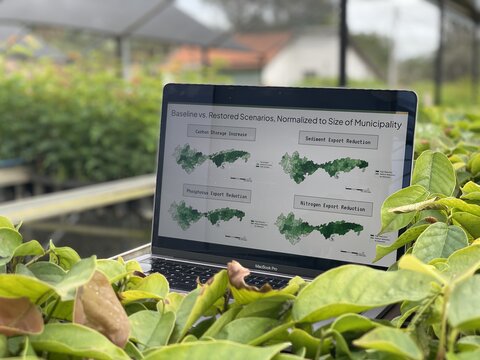
As expected, restored areas stored more carbon and leaked less nitrogen, phosphorus, and sediment. Overlaying and normalizing these results produced heatmaps revealing which regions offer disproportionate benefits: directly informing the priorities for restoration.
Conclusion
In short, without animals, plants, and biodiversity, humans would face food shortages, water scarcity, and increased disease outbreaks– making forest conservation and restoration a global priority.
I loved this project because it provided a clear example of how computer science tools can directly inform environmental science policy decisions. I also had the incredible opportunity to collaborate with amazing people from different disciplines and discover an entirely new culture!
If you want to learn more about the Atlantic forest, feel free to check out my 5-part series and podcast episode The Invisible Forest - A Story of People, Forests, and Technology in the Atlantic Forest.
You can also find a video summary of my visit in Brazil here: https://youtu.be/eylfzwB5E4g?si=PfFp9qm0saBescaP
Acknowledgements
This project was performed as part of the Mentoring Undergraduates in Interdisciplinary Research (MUIR) 2025 program together with Hilary Brumberg, Wambua Kithusi Musyoki, and Olavo Campelo for the non-profit organization SOS Mata Atlântica Foundation. Thank you to my collaborators and to SOS Mata Atlântica for hosting me in Brazil.
Explore More
-
Steps should be taken now to prevent anepidemic of H5N1 in humans and prepare for anoutbreak should it occur.
-
Stanford researchers quantify wildfire smoke exposure and mortality.


