
Scaling Up Rice-Fish Farming in Senegal: A Multi-Win Solution for Agriculture, Nutrition, and Health

Kayla Kauffman
Postdoctoral Scholar, De Leo Lab, Oceans
DECO Researcher
This past April, I spent a month in northwest Senegal launching an expansion of our rice-fish farming research recently published in Nature Sustainability. This region of the Sahel Desert is flat, sandy, and hot, but a large river and extensive dams and irrigation canals make it a highly productive rice-growing region. This water infrastructure also makes the area a hotspot for schistosomiasis, a water-associated parasitic disease vectored by freshwater aquatic snails—and that's exactly why we're here.
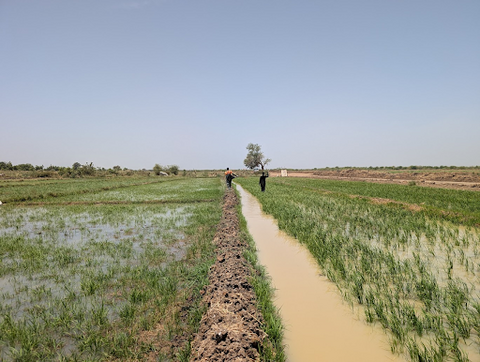
PC: Kayla Kauffman. Conducting snail sampling in rice paddies.
Why rice-fish farming?
Integrated rice-fish farming represents a rare multi-win solution. Research shows rice and fish grow better together than separately: rice yields can increase by about 20% while requiring fewer fertilizers, and fish need little to no feed at low densities. This diversifies farmers' incomes, making them more resilient to market volatility—critical for the smallholder farmers who produce around a third of the world's food.
For Africa, this matters enormously. The continent currently imports 42.4% more rice than it exports, and with the population expected to increase by 1 billion people by 2050 so does the need to produce more rice locally.
But there's another compelling reason we're pursuing this in Senegal: disease control. Rice farmers here face particularly high schistosomiasis burdens, with disease increasing alongside hectares farmed. Our collaborators' prior work showed that common aquaculture fish consume the snails responsible for transmission, suggesting integrated rice-fish farming might lower farmers' disease exposure.
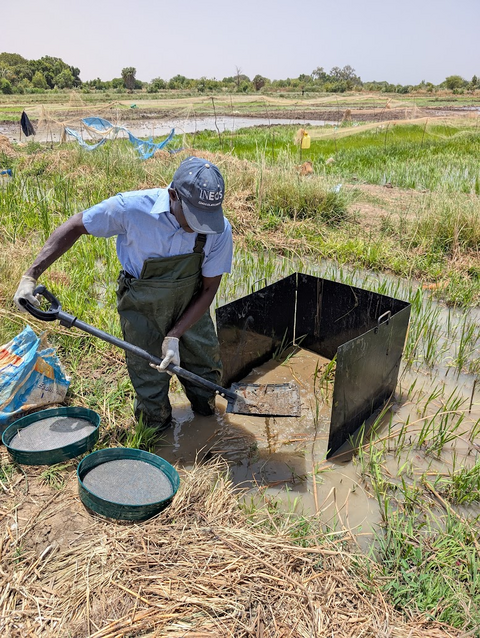
PC: Kayla Kauffman, Snail sampling in rice paddies using specialized shovel and sieves.
The fieldwork
During this trip, myself and a team of local researchers—veteran snail-finders and aquaculture specialists, many living in or near the study communities—conducted snail and ecological surveys in rice paddies then introduced fish to those fields.
Our days were spent navigating narrow berms along paddy edges wearing waders and gloves to access sampling points. Armed with specially designed shovels and sieves, we sifted through mud searching for snails. After sieving, there's still manual searching through plants and remaining sediment. The snails are surprisingly hard to find, making each discovery genuinely exciting, especially after several empty points.
Once conditions were right, we returned to introduce fish. They arrived in specially designed holding tanks mounted in pickup truck beds. At each site, we counted and weighed buckets of fish, then slowly acclimated them to the rice field water before release.
The farmers' enthusiasm is one of the best parts of this work. They gather to watch and help count fish and ask about fish care. We also held training sessions for enrolled farmers (though others could attend) on caring for fish in rice paddies, and plan to have more formalized training to help farmers learn about integrated rice-fish farming in the coming months.
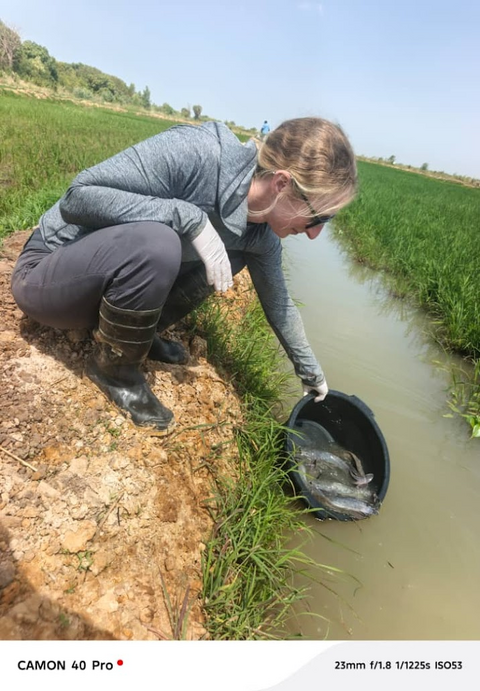
PC: Ndeye Mbaye. Introducing fish to the rice fields.
Looking ahead
When I return in July, we'll conduct post-treatment surveys—more mud-sifting for snails—plus measure environmental parameters like water quality and insect presence. We'll harvest, count, and weigh the fish to assess growth and survival, then give them to farmers to sell or prepare as food. Farmers will also quantify rice yields so we can compare growth between treatments.
Beyond Senegal, we envision scaling this approach across Africa wherever rice farming and aquaculture coexist—places like Kenya and Côte d'Ivoire. This project, supported by the Stanford Accelerator and conducted through the Disease Ecology in a Changing World (DECO) group at the Center for Human and Planetary Health, demonstrates how integrated agriculture might solve multiple problems for communities that need solutions most.

